Meta: Discover how bilingual early education boosts memory, focus, and flexible thinking in young children, plus how KV Montessori Academy weaves in daily Spanish.Why Bilingual Early Education Benefits Young Children
Bilingual early education gives young children a natural, everyday path to strong skills in two languages at once. Research from pediatric, education, and Montessori sources consistently shows that learning two languages in early childhood strengthens memory, attention, and flexible thinking without slowing down speech or school readiness. Ages 2 to 6 are an especially receptive window for absorbing language naturally. At KV Montessori Academy, daily Spanish lessons are woven into hands-on Montessori activities.
What Does Bilingual Early Education Actually Mean?
Bilingual early education means giving young children structured, daily exposure to two languages through real activities, songs, conversation, and hands-on work, not through translation drills or memorized vocabulary lists. The National Association for the Education of Young Children describes this kind of natural, everyday exposure to multiple languages as far more effective for young children than isolated language lessons.
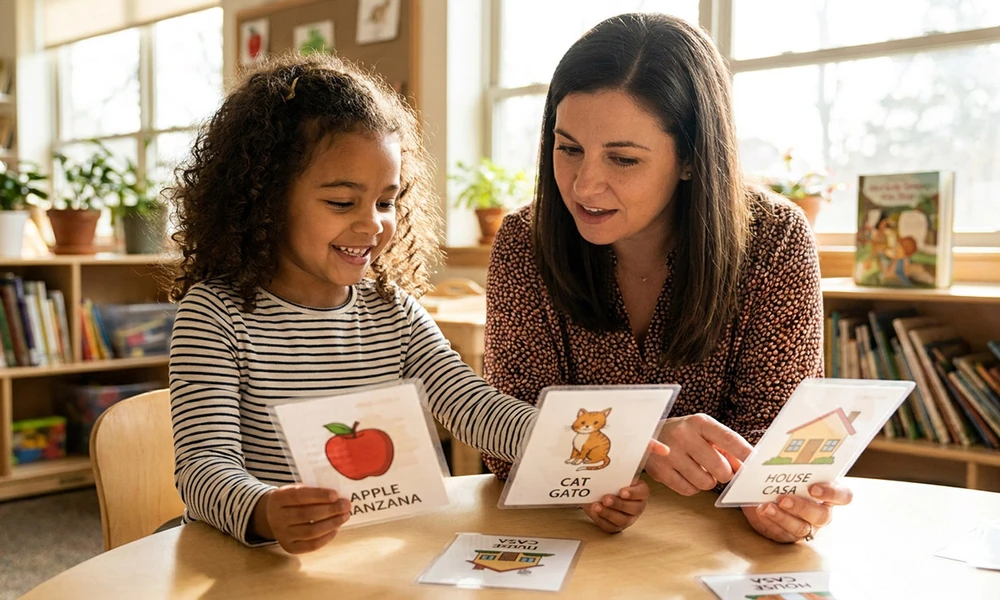
In a strong bilingual early childhood program, teachers speak directly to children in the target language while they work, cook, build, or play. A child learns the word for “water” while actually pouring it, not while sitting through a vocabulary quiz. That distinction matters, because it is the difference between a language a child memorizes and a language a child truly absorbs.
Such an approach looks different from a foreign language class for older students, which often relies on grammar rules and repetition. Young children do not need that scaffolding. Given consistent, warm exposure, they pick up sounds, rhythm, and vocabulary the same way they picked up their first language.
Will Two Languages Confuse a Young Child? How Bilingualism Shapes the Brain
Many parents worry that introducing a second language early will confuse their child or delay their first words, but current research does not support that fear. Zero to Three’s research on dual language development explains that bilingual children reach major speech and language milestones on a timeline similar to children learning only one language.
The American Academy of Pediatrics addresses such worry directly in its guide on common myths about bilingual children and language learning. Pediatricians note that any mixing of words between two languages in early childhood is a normal, temporary part of learning two systems at once, not a sign of confusion or delay.
Children absorb a second language the way they absorb their first: through daily life, not memorization.
It also helps to know that a bilingual child’s total vocabulary, counted across both languages, is often on par with or larger than a monolingual child’s. The two languages develop as connected parts of one growing communication system, not as competitors.
Cognitive Benefits of Bilingual Early Education: Memory, Focus, and Flexible Thinking
Growing up with two languages appears to give a young child’s brain extra practice at skills that go well beyond talking. Zero to Three’s overview of the many benefits of multilingualism points to stronger working memory and attention control in children who regularly use more than one language.
A peer-reviewed review of early bilingualism research, published through the National Library of Medicine, describes how switching between two languages gives children ongoing practice managing competing information and quickly shifting attention. Researchers often connect this practice to stronger executive function, the set of mental skills that helps a person plan, focus, and manage multiple pieces of information at once.
In everyday classroom terms, such behavior looks like a child pausing to choose the right word for the person they are talking to, or noticing quickly when a routine changes. Small moments, but they add up to real practice in flexible thinking.
Academic and Long-Term Learning Advantages
Beyond the early years, research suggests bilingualism tends to support certain academic skills over time, though it is a pattern in the research rather than a promise for any individual child. A study on second-language immersion published through the National Library of Medicine found associations between early dual-language learning and gains in areas like problem-solving and cognitive flexibility that can support later academic work.
These advantages build gradually rather than appear overnight. A child does not become bilingual in a single semester, and academic benefits, where researchers find them, tend to reflect years of consistent exposure. This is one reason many families look for daily bilingual instruction from the toddler years through kindergarten readiness, rather than an occasional language lesson.
Cultural Identity, Family Connection, and a Sense of Belonging
Beyond cognitive skills, bilingual early education helps children feel connected to their family’s language, culture, and extended community. NAEYC’s guidance on supporting children’s home language emphasizes that when a child’s home language is valued at school, it strengthens their sense of identity and their bond with family members who speak that language.
The American Montessori Society’s overview of dual-language immersion programs describes how this kind of program can connect a child to their own heritage and to a wider world beyond it. For a child in a bilingual Spanish and English classroom, this might mean singing a song a grandparent also knows or greeting a classmate’s family in a shared second language. For many families, this sense of belonging is one of the main reasons they seek bilingual early education in the first place.
Why Ages 2 to 6 Are a Naturally Receptive Window for Language
Early childhood is often described in Montessori education as a period of the “absorbent mind,” a term Dr. Maria Montessori used to describe how young children take in enormous amounts of information from their environment simply by living in it, without conscious effort. Language is one of several “sensitive periods,” or windows of especially strong natural interest, that Montessori observed in children roughly between birth and age six, as described in archived research from the NAMTA Journal.
During this window, children are not working hard to learn language the way an older student studies for a test. They are simply soaking it in, just as they absorb the sound of a favorite lullaby or the layout of their home. This does not mean there is a narrow deadline or that older children cannot learn a second language well. It simply means that ages 2 to 6 offer an especially natural, low-pressure time for language to take root through everyday exposure.
How Bilingual Early Education Comes to Life at KV Montessori Academy
At KV Montessori Academy, daily Spanish instruction is woven directly into hands-on Montessori activities rather than taught as a separate subject on a schedule. Children hear and use Spanish while pouring, sorting, singing, and working with Montessori materials, the same natural, everyday exposure that research points to as most effective for young learners.
This approach runs across our classrooms in Eastlake and Chula Vista, from the Toddler program through Primary Advanced. You can see how bilingual instruction fits into a typical day on our curriculum page and learn more about our teaching team and philosophy on our About Us page. For families who want to go deeper into related topics, our blog covers more about Montessori philosophy and early childhood development.
A bilingual classroom does not divide a child’s attention. It gives a growing mind more to work with.
The Bottom Line
Bilingual early education gives young children a natural, low-pressure way to build strong skills in two languages, along with meaningful gains in memory, attention, and flexible thinking. These benefits tend to build gradually over consistent, everyday exposure, especially during the early childhood years when language learning comes most naturally. Every child develops at their pace, and this article is general educational information, not a guarantee of specific outcomes for any individual child.
Curious what a Montessori day actually looks like for your child? Come see it in person. KV Montessori Academy welcomes families in Eastlake and Chula Vista to tour our classrooms and meet our teachers. Schedule a Tour or call (619) 730-4020.
Frequently Asked Questions
Will learning two languages at once confuse my child or delay their speech?
No. Research from the American Academy of Pediatrics and Zero to Three both find that bilingual children reach speech and language milestones on a similar timeline to children learning one language. Occasional mixing of words between languages is a normal, temporary part of managing two language systems and is not a sign of confusion or delay.
What age is best for a child to start learning a second language?
There is no strict cutoff, but ages 2 to 6 are considered an especially receptive window because young children absorb language naturally through everyday exposure rather than deliberate study. Montessori educators describe this period as part of the “absorbent mind,” when children take in language simply by living surrounded by it. Older children and even adults can still learn a second language well, it may just require more conscious effort.
Do we need to already speak Spanish at home for our child to benefit from a bilingual Montessori program?
No, many families enrolled in bilingual programs do not speak the target language at home. Children build their second language primarily through classroom exposure, and consistent daily practice at school is often enough to build real comfort and skill over time. Parents are welcome to reinforce what their child is learning, but it is not required for the program to work.
How is Spanish taught in a Montessori classroom instead of a traditional language class?
Rather than a separate period set aside for language lessons, Spanish is used throughout the regular Montessori day during practical life activities, songs, stories, and hands-on materials. This mirrors how children naturally acquire their first language, through repeated, meaningful use rather than memorization. At KV Montessori Academy, this means children hear and use Spanish while they are already engaged in something they enjoy.
Will being bilingual give my child an academic advantage later on?
Research suggests a pattern of cognitive benefits, such as stronger working memory and flexible thinking, that can support later academic skills, though outcomes vary by child. These benefits tend to reflect years of consistent bilingual exposure rather than a guarantee tied to any single program. Just as consistent in the research is the confidence and connection bilingual children often gain alongside these cognitive habits.